
University research lab interior with golden afternoon light, inventor at a workbench

Resources for student inventors moving from university lab to commercialized venture. Coverage of IP strategy, early-stage funding, and the mentor relationships that matter.

The Importance of Mentorship in Early-Stage Ventures

Experienced mentor and young entrepreneur in an engaged office conversation over coffee

There is a category of knowledge that does not exist in textbooks, courses, or online guides. It lives in the minds of people who have already navigated the specific terrain you are about to cross: a first licensing negotiation, a difficult co-founder conversation, a pivot decision, a first customer who walks away. That knowledge transfers through mentorship, and for early-stage founders, it is one of the most valuable resources available.

Programs like Invention to Venture recognized this early. Regional workshops were not designed simply to deliver curriculum; they were designed to put student inventors in the same room as practitioners who had walked the commercialization path before. The curriculum was a vehicle. The mentor relationships were the lasting output.

What a Good Mentor Actually Provides

Mentors are often described in abstract terms: guidance, wisdom, encouragement. In practice, the value is more specific.

Pattern recognition. Experienced founders have seen enough situations that they recognize patterns quickly. When you describe a problem, a strong mentor does not just listen. They say, “I have seen this before, and here is what usually happens next.” That pattern recognition compresses your learning timeline significantly.

Honest challenge. The people closest to you (teammates, family, early supporters) are usually inclined to encourage. That is useful for motivation but limiting for decision-making. A mentor with no stake in your outcome can tell you when your assumptions are wrong, when your pitch has a logical gap, or when you are pursuing the wrong market. That honest challenge, delivered with expertise, is rare and worth seeking.

Network access. An introduction from a credible mentor opens doors that a cold email cannot. Investors, potential customers, regulatory advisors, and hiring candidates respond differently to a contact introduced by someone they respect. This is not a minor convenience; it can be the difference between getting a first meeting and not getting one.

Accountability. Declaring a specific goal to a mentor and then reporting back on progress creates a different kind of accountability than a personal to-do list. Founders who meet regularly with mentors tend to move faster because they commit to short-term milestones and report against them.

The Difference Between a Mentor and an Advisor

These terms are often used interchangeably, but there is a meaningful distinction. An advisor typically has a formal (if minor) equity stake in the venture and may attend periodic board or strategy meetings. A mentor relationship is more informal: usually no equity, no formal commitment, and no defined deliverable.

Neither is inherently better, but they serve different purposes. Advisors are appropriate when you need someone reliably available for a specific functional area (say, regulatory strategy or enterprise sales) over a sustained period. Mentors are appropriate when you need access to judgment and experience without formal structure.

For most student inventors early in the commercialization process, mentors are the right starting point. The overhead of formalizing advisor agreements, issuing equity, and setting board expectations is not appropriate until the venture has enough shape to warrant it.

Where to Find Mentors

The strongest mentor relationships usually develop from structured contexts rather than cold outreach. Programs specifically designed around technology commercialization, such as regional workshops, accelerator cohorts, and I-Corps programs, create natural mentoring environments. The shared context of working on similar problems accelerates the trust-building that makes a mentoring relationship useful.

Specific sources worth pursuing:

University alumni networks. Alumni who founded or joined technology ventures often maintain strong connections to their schools and actively look for opportunities to give back. Your technology transfer office or entrepreneurship center can facilitate introductions.

Industry and startup events. Demo days, pitch competitions, and sector-specific conferences bring practitioners and founders into the same room. Thoughtful conversations at these events frequently evolve into ongoing relationships.

Startup accelerators and incubators. Even if you are not accepted to a program, attending associated events or reaching out to program alumni is a legitimate path. Accelerator mentor networks are often open to broader community engagement.

Faculty with commercial experience. Not all faculty have commercialization experience, but those who have licensed technology, founded companies, or consulted extensively in industry bring a perspective that purely academic advisors cannot match. Finding one or two of these individuals early in your program is worth the effort.

How to Structure the Relationship

Reaching out to a potential mentor with a vague request (‘I would love to pick your brain’) is both common and ineffective. It puts the burden on the mentor to define the scope, and it signals that you have not thought carefully about what you need.

A better approach: lead with specificity. Describe who you are, what you are working on, what specific challenge you are facing, and why you believe this person’s experience is relevant to that challenge. Then ask for a defined, low-commitment first conversation: thirty minutes, a specific question, a concrete problem to discuss.

After that first conversation, if the relationship has value, follow up with what you did with the input you received. Mentors invest more in founders who demonstrate that their advice creates action.

As the relationship develops, establish a rhythm. Monthly or biweekly check-ins with a short written update beforehand are a format that many experienced mentors find efficient. It keeps the conversation focused and respects their time.

The Obligations of the Mentee

Mentorship is not a passive transaction. The founders who get the most from mentor relationships treat them as two-way exchanges of value.

This means preparing for conversations rather than improvising. It means following through on commitments made in previous sessions. It means updating your mentor on how their input shaped your decisions, even when the update is that you chose a different direction and here is why.

It also means being honest about failures and setbacks. Mentors who only hear about wins cannot help you navigate difficulty. The most productive mentoring conversations often start with a candid description of what went wrong.

Building a Mentor Network Over Time

The right mentor for the problem of starting a company is not necessarily the right mentor for the problem of scaling one. Expect your network of mentors and advisors to evolve as your venture evolves.

Be deliberate about maintaining relationships even when you are not actively drawing on them. A brief update email, a relevant article, or an invitation to a milestone event keeps a dormant relationship warm. The mentor you do not need today may be exactly the right person for a challenge you will face in eighteen months.

Invention to Venture’s regional programs were built on this principle: that concentrated time with experienced practitioners, structured around real ventures and real problems, created lasting networks. The curriculum ended. The relationships continued to generate value for years afterward.


Related Reading: From Lab to Market: A Practical Guide for Student Inventors | How to Secure Seed Funding for Your Tech Startup

How to Secure Seed Funding for Your Tech Startup

Two entrepreneurs reviewing financial charts on a laptop in a startup workspace

Capital is the fuel for early-stage ventures, but not all capital is the same. The source of your funding shapes how quickly you grow, how much ownership you retain, and what obligations you carry. For student inventors and early-stage technology entrepreneurs, understanding the full map of seed funding options, matching each to the right stage, is one of the most practical skills you can develop.

This article covers the major categories of seed-stage funding available to tech startups, with particular focus on the resources that student innovators can access before and immediately after leaving the university environment.

Non-Dilutive Funding: Start Here

Non-dilutive funding means capital that does not require giving up equity in your company. For pre-revenue ventures with unproven commercial potential, this is the right place to start.

University and Program Grants

Many universities maintain internal proof-of-concept funds designed specifically to derisk technologies before licensing. These programs typically offer between $10,000 and $100,000 for prototype development, market validation, or regulatory work. Check with your technology transfer office or innovation center to understand what is available at your institution.

Program-level grants, such as the E-Team grants offered through the National Collegiate Inventors and Innovators Alliance, were designed to support student-led ventures at critical early stages. These grants often came paired with mentorship, workshops, and peer networks; the non-financial value frequently exceeded the dollar amount.

NSF I-Corps

The National Science Foundation’s Innovation Corps program provides $50,000 in funding to teams of NSF-funded researchers and their entrepreneurial leads. The grant is tied to a seven-week intensive program requiring extensive customer discovery, typically more than 100 interviews.

I-Corps is not just a funding mechanism. It is a structured methodology for testing whether a technology has commercial relevance. Teams that complete the program come away with a validated (or redirected) value proposition and a network of mentors and program alumni. For student inventors with deep technical expertise but limited business experience, I-Corps is one of the highest-leverage opportunities available.

SBIR and STTR Programs

Small Business Innovation Research (SBIR) and Small Business Technology Transfer (STTR) programs fund early-stage technology companies through federal agencies including NIH, DOD, NSF, and DOE. Phase I awards typically range from $150,000 to $300,000 for six to twelve months of feasibility work. Phase II awards can reach $1 million or more.

STTR specifically requires a formal partnership between a small business and a research institution, making it well suited for student-founded ventures that maintain a university collaboration. The application process is rigorous, but SBIR/STTR funding is non-dilutive and government-validated, both of which help with subsequent fundraising.

Equity Funding: When You Are Ready to Trade Ownership for Speed

Equity funding means exchanging a portion of your company for capital. This accelerates growth but creates obligations: to your investors, your board, and eventually your employees and customers.

Angel Investors

Angel investors are typically high-net-worth individuals who invest their own money in early-stage companies. They often invest in sectors they understand from personal or professional experience, and the best angels bring domain expertise alongside capital.

Angels usually invest at the pre-seed or seed stage, in rounds ranging from $25,000 to $500,000. Finding angels who have experience with technology commercialization (particularly in your specific industry) is more valuable than finding those who simply have money available.

University alumni networks are an underused resource for angel introductions. Many successful technology entrepreneurs who graduated from research universities stay connected to their alma maters and actively look for opportunities to support student ventures.

Accelerators and Incubators

Accelerators offer a defined cohort experience: a period of three to six months, structured programming, access to a mentor network, and a small amount of capital (typically $20,000 to $150,000) in exchange for equity (typically 5 to 10 percent). The most selective accelerators (Y Combinator, Techstars, and sector-specific programs) also carry brand value that signals quality to subsequent investors.

University-affiliated incubators often offer longer timelines, lower equity requirements, and facilities access. For hardware and life sciences ventures that need lab space or equipment, an incubator arrangement may offer more practical value than a purely financial program.

Choose an accelerator based on the quality of its mentor network in your specific industry, the success of its alumni companies, and whether the program timeline fits your current stage. Entering too early, before you have a validated problem and a credible team, wastes a competitive slot.

Venture Capital

Venture capital is appropriate for ventures that have demonstrated clear product-market fit, a replicable customer acquisition model, and a credible path to significant scale. Most student ventures are not venture-ready at the time of founding, and that is normal.

The sequencing matters: grants and program funding first, then angel or pre-seed rounds once commercial traction is established, then venture capital once the growth model is validated. Trying to skip ahead to institutional venture capital without evidence of traction is almost always counterproductive.

Preparing to Raise: What Every Funder Looks At

Regardless of funding source, investors and program officers evaluate the same core elements:

Problem clarity. Is the problem real, significant, and clearly defined? Can the team articulate who has this problem and how they experience it today?

Solution differentiation. Is the technology meaningfully better than alternatives, and is that advantage defensible over time?

Team credibility. Does the team have the technical depth to execute and the self-awareness to recruit for gaps?

Stage-appropriate evidence. A grant application requires customer discovery data. An angel pitch requires early users or letters of intent. A venture pitch requires revenue and retention metrics.

Use of funds. Can you explain specifically what milestones this funding will help you reach, and why those milestones are the right ones for your stage?

A Note on Sequencing

The most common funding mistake at the student stage is pursuing the wrong type of capital too early. Equity funding sought before a venture has demonstrated commercial viability dilutes founders unnecessarily and creates pressure that can distort product decisions.

The better approach: use non-dilutive funding to reach proof-of-concept and initial customer validation. Use that evidence to access program-level support like I-Corps or an accelerator. Use that network and credibility to approach angels with a story that is grounded in evidence rather than aspiration.

Capital follows evidence. Build the evidence first.


Related Reading: From Lab to Market: A Practical Guide for Student Inventors | The Importance of Mentorship in Early-Stage Ventures

From Lab to Market: A Practical Guide for Student Inventors

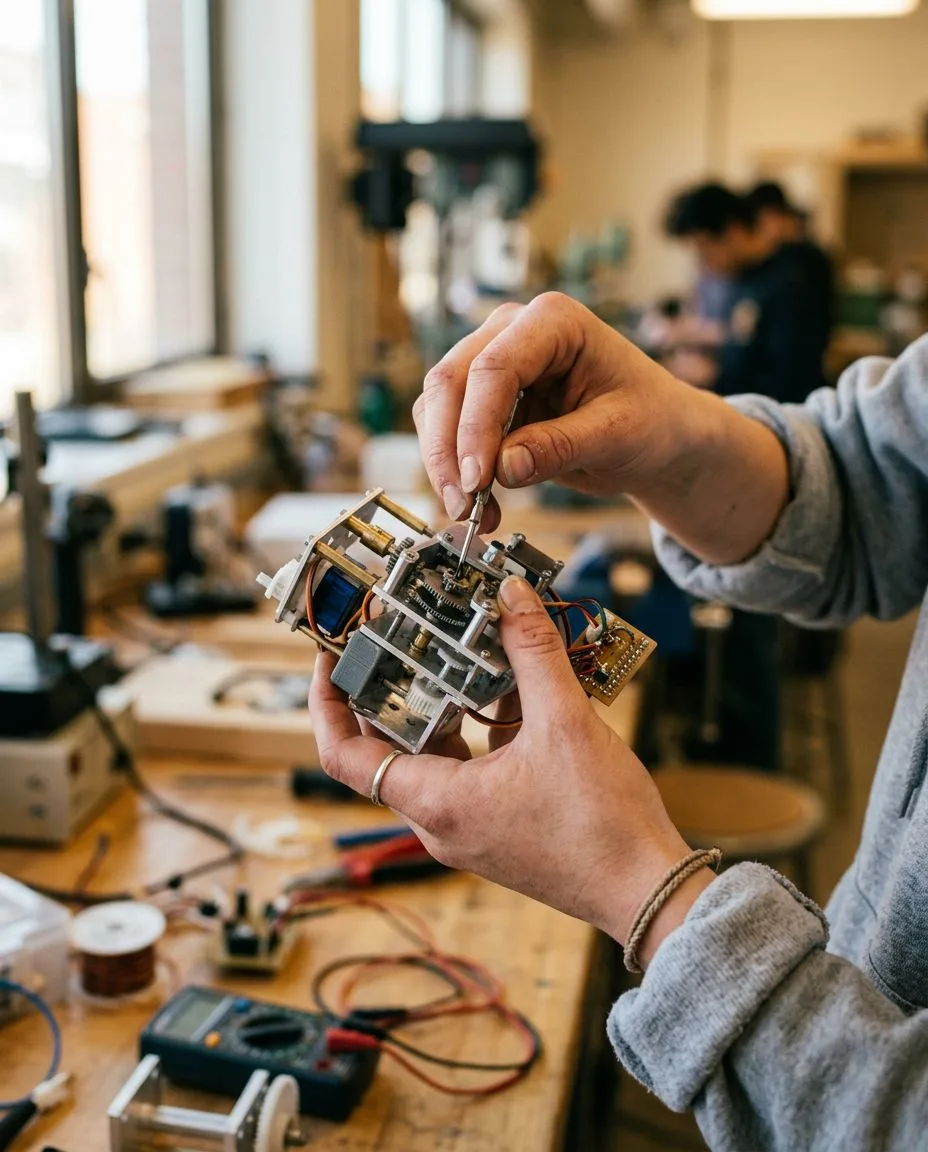
Student inventor examining a small mechanical prototype in a university workshop

Most student inventors reach the same crossroads: a working prototype sits on the bench, advisors are enthusiastic, and the question becomes what to do next. The jump from academic research to a functioning venture is not accidental. It follows a sequence of deliberate steps, and understanding that sequence early saves months of wasted effort.

This guide draws on the framework that programs like Invention to Venture developed to support students at exactly that crossroads, moving a promising idea out of the university lab and into the hands of people who need it.

Understand What You Actually Have

Before pitching anyone, take time to describe the invention in plain language. If you cannot explain what problem it solves and for whom in two sentences, you are not ready to commercialize it. Clarity of problem and solution is the starting point for every decision that follows.

Ask three questions:

  1. Who has this problem right now, and how are they currently solving it?
  2. Why is your solution meaningfully better: faster, cheaper, safer, or more reliable?
  3. Is there a large enough group of people with this problem to support a sustainable business?

Answering these questions does not require a formal market study. Start by talking to ten potential users. Their language and objections will shape how you frame every subsequent document, from patent claims to investor decks.

Protect the Core Before You Share It

Intellectual property protection is not bureaucratic overhead. It is the asset that gives a technology-based venture its defensible position. Universities typically own inventions made with institutional resources, so the first conversation should be with your technology transfer office.

Work with your institution’s licensing staff to understand whether a patent, trade secret, or copyright best fits your invention. For most hardware and biomedical innovations, a provisional patent application is a practical first step. It establishes a priority date and gives you twelve months to develop the commercial case before committing to full prosecution costs.

Even before filing, document everything: lab notebooks with dated entries, email trails, and version logs. This documentation becomes critical if priority disputes ever arise.

Validate Before You Build

A common and expensive mistake is spending months refining a product before confirming that anyone will pay for it. Market validation does not mean a formal survey. It means finding five to ten potential buyers or partners willing to describe their problem in detail and, ideally, willing to give you a letter of intent, a pilot agreement, or a small purchase order.

For medical devices or regulated products, validation also means understanding the regulatory pathway. A product that requires a 510(k) clearance has different development timelines and capital requirements than software sold directly to consumers. Knowing this early shapes your funding strategy and your team-building priorities.

Build the Right Team

Solo inventors rarely build successful ventures. The combination of technical depth and business execution that a commercialization effort requires almost always spans more than one person’s skills.

Look honestly at what your team currently covers and what it is missing. A biomedical engineer with a strong device prototype may need a regulatory expert, a clinician champion, and someone experienced in sales or business development. University programs, incubators, and competitions are practical places to find co-founders and advisors with complementary skills.

Mentors who have commercialized technology before are particularly valuable. They have navigated the specific bottlenecks (licensing negotiations, early customer conversations, Series A term sheets) that no coursework fully prepares you for.

Pursue Early-Stage Funding Strategically

Student inventors have access to funding sources that disappear once they graduate. E-Team grants, for example, were designed specifically to support student-led technology ventures at the proof-of-concept and prototype stages. National Science Foundation I-Corps funding operates on a similar principle: short, intensive validation programs paired with modest financial support.

These programs serve two purposes. They provide capital, but more importantly, they force structured thinking. An I-Corps cohort requires dozens of customer discovery interviews in a matter of weeks. That discipline accelerates learning faster than months of independent research.

As you move beyond student grants, understand the difference between grants, equity investment, and revenue-based models. Each has different implications for ownership, control, and speed. A grant requires reporting but preserves equity. An angel investment accelerates growth but requires you to share upside and accept oversight.

Use Institutional Resources While You Have Access

University resources (wet labs, prototyping equipment, faculty advisors, and peer networks) are available to you at dramatically lower cost than they would be post-graduation. Use them deliberately. Run experiments that derisk the technical core. Use the machine shop or fabrication lab to build and iterate on prototypes. Attend workshops and regional programs focused on commercialization.

Regional programs like Invention to Venture workshops brought student inventors together with mentors, investors, and peers working on similar challenges. The value was not only the curriculum but the network formed in those sessions. Many early partnerships and co-founder relationships emerged from that kind of structured proximity.

Plan the Transition

At some point, the venture requires full-time attention. Plan that transition rather than letting it happen by default. Know when you need to leave your academic program, whether a leave of absence serves you better than withdrawal, and how your university’s conflict-of-interest policies affect your ability to license technology from your own research.

The path from lab to market is not linear, but it is navigable. The inventors who move successfully are not necessarily the ones with the best technology. They are the ones who treat commercialization as a discipline, seek structured feedback early, and build the team and resources their venture actually needs.


Related Reading: How to Secure Seed Funding for Your Tech Startup | The Importance of Mentorship in Early-Stage Ventures